TL;DR: When Do You Need Glass?
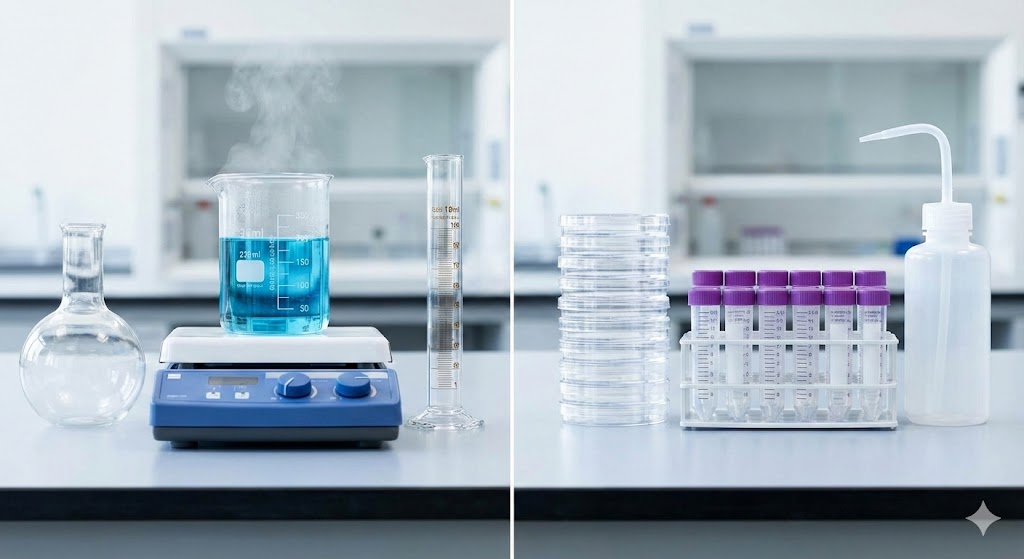
Use glass when your work involves heat, strong solvents, tight volume accuracy, or contamination-sensitive measurements. Glass is also “mandatory” any time your SOP, method, or regulator calls for it. Plastic is great for sterile, disposable, low-risk steps, but it can warp with heat, absorb chemicals, or add trace contaminants. And one big exception: hydrofluoric acid (HF) attacks glass, so glass is the wrong choice there.
If you only remember one thing, remember this: Heat + Solvents + Accuracy + Cleanliness = glass.
Sterile + Disposable + Drop Safety + Low Heat = plastic.
Now let’s make that practical.
Are You Choosing For One Experiment Or Standardizing A Whole Lab?
People usually ask this question right before they lose a day to a cracked bottle, a warped tube, or a weird “mystery peak” that came from the container instead of the sample. We’ve all seen it.
So first, decide what you’re doing:
If you’re choosing for one experiment, you can pick the safest material for that specific chemical, temperature, and measurement step.
If you’re trying to standardize a lab, you want fewer container types, fewer “I thought this was fine” moments, and easier training. In that case, you create a short labware playbook. It can be one page. It saves you a surprising amount of time.
Either way, we’ll use the same decision logic.
What’s The Real Difference Between Glassware And Plasticware?
Glass is generally more inert. It stays stable when you heat it. It also cleans well, which helps if you reuse it.
Plastic is lighter and harder to break. It’s also easy to buy sterile and disposable. That alone makes it a winner in many biology workflows.
But plastic comes with tradeoffs that aren’t obvious until something goes wrong:
- Some plastics absorb organics or let solvents pass through slowly.
- Some plastics leach tiny amounts of additives.
- Many plastics deform under heat or pressure.
And one more thing: “plastic” is not one material. PP, PE, PS, PC, PTFE—these behave like totally different worlds. If you treat them as interchangeable, you’ll eventually get burned. Sometimes literally.
What Type Of Glass Are We Talking About?
When people say “glass,” they often mean borosilicate. That’s the typical lab workhorse. Still, it helps to know the main categories.
Borosilicate Glass: When You Heat Or Use Solvents
Borosilicate glass handles thermal stress better than regular household glass. It’s why most chemistry labs use it for beakers, flasks, and bottles.
Use borosilicate when you:
- heat liquids on a hot plate
- run reflux or distillation setups
- mix organic solvents
- need a container that keeps its shape and volume
It’s not indestructible. Drop it once and you’ll find out.
Soda-Lime Glass: When Heat Does Not Matter
Soda-lime glass shows up more in basic settings and low-heat use. It’s cheaper. It also hates sudden temperature changes.
If your workflow involves repeated heating, cooling, or direct heat, don’t “save money” here. You’ll pay for it in breakage.
Quartz Glass: When Optics Are The Requirement
Quartz is not a “nice-to-have” in the workflows that need it. If you run UV measurements and the method calls for quartz cuvettes, use quartz. Don’t try to hack it with plastic and hope for the best.
If your measurement depends on light passing through the container, the container becomes part of the instrument. Treat it that way.
What Type Of Plastic Are We Talking About?
Here’s the part that causes the most confusion.
“Plastic labware” can mean:
- Polypropylene (PP): common, tough, often autoclavable
- Polyethylene (HDPE/LDPE): great for storage, flexible options
- Polystyrene (PS): common for disposable items, hates many solvents
- Polycarbonate (PC): strong and clear, can crack with some chemicals
- Fluoropolymers (PTFE/FEP/PFA): high chemical resistance, usually premium
Your lab might also use specialty plastics for filtration, microfluidics, or solvent work. The key is simple: match the polymer to the chemistry.
If you don’t know the polymer, check the packaging, the product page, or the mold marking. Guessing is expensive.
When Is Glass Mandatory?
“Mandatory” can mean two things:
- The method requires it (SOP, regulatory method, internal QA rule)
- The physics and chemistry require it (plastic will fail or contaminate the work)
Let’s cover the real-world cases where glass is the right call.
Glass Is Mandatory When You Apply Direct Heat
If you heat a container directly, many plastics become a liability fast.
Plastic can:
- soften and sag
- lose its volume accuracy
- release residues into your liquid
Glass stays stable and predictable. That’s what you want when you heat, boil, reflux, or concentrate solutions.
If you ever see a tube start to “oval” in a rack during heating, you already learned this lesson the hard way.
Glass Is Mandatory When Your Solvent Will Attack Plastic
A lot of organic solvents can swell, soften, or stress-crack common plastics. People usually find out after the cap fuses on, the bottle turns cloudy, or the tube gets gummy.
Common examples that often cause trouble with many plastics:
- acetone
- toluene
- chloroform
- dichloromethane
We can’t give you one universal rule because compatibility depends on the exact plastic. Still, your safest workflow is consistent:
- Identify the solvent
- Identify the polymer
- Check a chemical compatibility chart from the supplier
- Pick glass if compatibility looks questionable
Yes, this adds five minutes. It also saves you from cleaning up solvent from the bottom of a cabinet.
Glass Is Mandatory When You Need Low Contamination
This is the sneaky one.
If you run trace analysis, standards, or sensitive chromatography work, the container can contribute its own “signal.” Plastic can leach tiny amounts of additives, slip agents, or residues from manufacturing. Many applications never notice. Sensitive workflows do.
Plastic can also adsorb some compounds onto its surface. That means your concentration drops for no obvious reason. You pipette carefully, you calibrate, you run the instrument, and the numbers still look wrong. Great.
Glass tends to behave better in these cases, especially when you clean it properly and use it consistently.
Glass Is Mandatory When You Need Volumetric Accuracy
When a method calls for Class A volumetric glassware, it’s calling for known tolerances and known behavior.
That matters when you:
- prepare standards
- run titrations
- report concentrations with tight error ranges
- do regulated work where auditors care about equipment class
Plastic graduated cylinders and disposable tubes are fine for rough work. They aren’t fine for “this concentration must be right” work.

Glass Is Mandatory When The SOP Or Regulator Says It Is
This is the simplest “mandatory” category.
If the method says:
- borosilicate glass
- glass-only container
- a specific standard method that implies glassware class
…then use it.
Even if plastic would “probably be fine,” compliance isn’t built on “probably.” Put the container type in your run notes. Future-you will thank you.
When Is Plastic The Better Choice?
Plastic wins when you want sterility, speed, and impact resistance.
Here are common places plastic shines:
Sterile, Single-Use Workflows
If you do cell culture, clinical sampling, routine buffer prep for biology, or anything where sterility matters more than solvent resistance, plastic makes life easier.
You can buy it sterile. You can keep it closed. You can throw it away after one use. That cuts down cross-contamination.
High Breakage Risk Environments
Teaching labs, busy benches, shared spaces—these are places where glass breaks. Broken glass wastes time and creates injuries.
Plastic reduces that risk. It also makes transport easier. If you carry samples between rooms, plastic can be the safer default.
Centrifugation And Routine Handling
Most centrifuge tubes are plastic for a reason. They’re designed for that mechanical stress, and they fit the equipment.
Still, don’t assume all centrifuge tubes are compatible with all solvents. Many aren’t.
When Is Plastic Mandatory Or Safer Than Glass?
This section matters because people often treat “glass is better” as a universal truth. It isn’t.
HF: Glass Is The Wrong Choice
Hydrofluoric acid attacks glass. If you work with HF, you need compatible plastics. Labs often use fluoropolymer containers for that reason.
If your work involves HF or related fluoride chemistry, don’t freestyle this choice. Follow the SOP and compatibility guidance exactly.

Breakage Creates A Bigger Hazard Than Spillage
Sometimes glass breakage is the top risk. Think of crowded floors, field sampling, and high-traffic areas.
In those settings, plastic can reduce injuries. It can also reduce downtime, since you won’t be cleaning shards out of places they don’t belong.
Glassware vs Plasticware Comparison Table
Here’s a table you can use to decide quickly, then double-check the one factor that can ruin your experiment.
| Decision Factor | Glass | Plastic | Best Default | Notes |
| Direct Heat | Excellent | Often poor | Glass | Plastic may deform or leach |
| Organic Solvents | Often strong | Depends on polymer | Glass | Verify polymer compatibility |
| Sterile Single-Use | Not typical | Excellent | Plastic | Especially in bio workflows |
| Volumetric Accuracy | Excellent (Class A) | Usually lower | Glass | For standards, titrations |
| Trace Contamination | Often lower | Can leach/adsorb | Glass | Depends on analysis sensitivity |
| Drop Safety | Poor | Good | Plastic | Glass breakage = hazard |
| Long-Term Reuse | Good | Mixed | Glass | Plastic can stain/retain odors |
| HF Compatibility | Bad | Better (specific plastics) | Plastic | Follow SOP and compatibility chart |
| Cost Over Time | Mixed | Mixed | Depends | Glass lasts; plastic is disposable |
| Waste Profile | Wash/reuse | Disposable | Depends | Your lab’s policies matter |
If you want a fast pick, choose the “Best Default,” then check the “Notes” column. That’s where the disasters hide.
A Simple Decision Path You Can Use Every Time
If you want a rigorous, repeatable method, use these five questions in order:
1) What Chemicals Touch The Container?
List the solvent, acid/base, salts, and any additives. Then match them to the container material.
If you can’t confirm compatibility for the plastic, don’t use it for that chemical. Use glass or a verified compatible polymer.
2) Will You Heat It, Chill It, Or Autoclave It?
Heat pushes many plastics past their limits. Autoclaving adds pressure and steam, which can warp some plastics and stress caps and seals.
Glass handles heat better. Some plastics handle autoclaving well. Many do not. Check the product’s stated temperature rating.
3) Are You Measuring Volume Or Just Holding Liquid?
If you’re measuring, you need accuracy. If you’re holding, you need compatibility and safety.
That one distinction removes a lot of confusion.
4) Is This Trace Work Or “Normal” Concentrations?
If you’re working near the detection limit of your instrument, containers matter more.
For trace work, prefer glass unless the method requires a specific polymer, or unless the chemistry rules glass out.
5) What’s The Real Safety Risk?
Ask this out loud: “What’s the worst thing that happens if this breaks or leaks?”
If the answer is “someone gets hurt,” pick the safer handling option and follow the SOP.

Common Mistakes People Make When Choosing Labware
Let’s keep this honest. These mistakes happen in real labs every day.
Mistake 1: Treating All Plastics As The Same
PP is not PS. PC is not PTFE. This is the root of a lot of failures.
If you only change one habit, change this one: always identify the polymer.
Mistake 2: Heating In A Container That Was Never Meant For Heat
People do this when they’re in a hurry. The container survives. The sample does not.
Warped plastic changes volume. It can also release residues. That ruins your numbers, and you may not notice until later.
Mistake 3: Using The Same Plastic Container For Everything
Plastic can retain odors, stains, and residues. It can also scratch. Scratches trap contaminants.
Single-use plastic helps with cross-contamination. Reusing disposable plastic often does the opposite.
Mistake 4: Ignoring Adsorption
Some analytes love to stick to plastic. If your concentration drops for no reason, and your QC keeps drifting, the container might be the problem.
Mistake 5: Forgetting That Compliance Is Part Of The Experiment
If the method calls for glass, use glass. If it calls for a specific polymer, use that polymer.
A perfect technique still fails an audit if the materials are wrong.
FAQ
Is Glass Always More Chemically Resistant Than Plastic?
Not always. Glass handles many solvents well, but certain chemicals attack glass. HF is the famous one. Plastics vary widely, and some fluoropolymers resist chemicals that would damage other materials.
Use a compatibility chart for the exact chemical and the exact polymer. That’s the safe way to answer this question.
When Should I Use Borosilicate Glass Specifically?
Use borosilicate when you heat, when you face thermal swings, and when you want a stable, reusable container for general chemistry.
It’s a strong default for:
- hot plate work
- reflux/distillation setups
- routine mixing and storage of many lab reagents
When Is Plastic Better For Sterile Work?
Plastic is often better when you want sterile and disposable. That’s common in biology, clinical workflows, and sampling.
Still, “sterile” does not mean “solvent resistant.” Treat those as separate checks.
How Do I Know If A Method Makes Glass “Mandatory”?
Look for any of these:
- the SOP names glass, borosilicate, or a glassware class
- a standard method implies specific glassware tolerances
- QA/QC documentation requires a material type
If the method specifies it, follow it. If it doesn’t, use the decision path in this article.
Not always. Glass handles many solvents well, but certain chemicals attack glass. HF is the famous one. Plastics vary widely, and some fluoropolymers resist chemicals that would damage other materials.
Use a compatibility chart for the exact chemical and the exact polymer. That’s the safe way to answer this question.
Plastic is often better when you want sterile and disposable. That’s common in biology, clinical workflows, and sampling.
Still, “sterile” does not mean “solvent resistant.” Treat those as separate checks.
Look for any of these:
the SOP names glass, borosilicate, or a glassware class
a standard method implies specific glassware tolerances
QA/QC documentation requires a material type
If the method specifies it, follow it. If it doesn’t, use the decision path in this article.
Conclusion: Pick The Material That Protects Your Data
Use glass when heat, solvents, accuracy, or low contamination sit at the center of your workflow. Use plastic when sterility, speed, and drop safety matter more, and always match the polymer to your chemistry. If you want to make this even easier, write a one-page “labware rule sheet” for your lab: the common chemicals you use, the approved container materials, and the few red-line exceptions (HF is usually on that list).
If you tell us what you’re working with—your solvents, temperatures, and whether you’re measuring volumes or just storing—we can help you map each step to the right glass or plastic choice and turn it into a checklist your whole team can follow.