Fractional distillation separates a liquid mixture by repeatedly bringing vapor and liquid into contact inside a fractionating column. When the mixture permits separation, successive vapor–liquid exchanges enrich the rising vapor in the more volatile component; condensing that vapor yields a distillate of different composition from the feed.
Key takeaways
- A fractionating column adds separation by repeating condensation–vaporization contact (reflux and enrichment), not by a single boil-off event.
- A collected fraction is a portion of distillate—not proof of purity; composition still needs an appropriate analytical check.
- Choose the separation arrangement (simple vs fractional) and the operating pressure (atmospheric vs vacuum) as two separate decisions.
- Specify glassware by joint size, column type (Vigreux or packed), condenser style, receiver plan, and atmospheric vent or vacuum path—not by appearance alone.
WUBOLAB manufactures laboratory glassware used in distillation trains; this guide explains the method so buyers can specify components against a defined separation task rather than treat catalog parts as a substitute for a validated procedure.
A fraction may contain one compound or several. Collecting separate cuts and proving their composition remain different tasks. The sections below connect the column’s mechanism to the apparatus, the choice of operating pressure, and the checks needed before treating a collected fraction as the desired product. UCLA’s distillation definitions · HKUST’s distillation introduction
Table of contents
- How a fractionating column works
- Fractional distillation apparatus
- From setup to collected fractions
- Simple vs fractional distillation (and vacuum)
- Laboratory and petroleum applications
- Separation limits, troubleshooting, and safety
- Specifying laboratory glassware
- Fractional distillation FAQ
How a fractionating column works
Vapor enrichment and reflux
A mixture does not usually behave as though one liquid waits for the other to finish boiling. Both volatile components can enter the vapor. Their contributions depend on the liquid composition and vapor-liquid equilibrium: the relationship between the coexisting liquid and vapor under the operating conditions. For a separable mixture, the vapor can contain a greater proportion of the more volatile component than the liquid does. LibreTexts: separation theory
The column repeats this enrichment. Vapor rises from the flask, contacts liquid on the column’s surfaces, and undergoes successive condensation and vaporization. Liquid returning down the column is reflux; vapor continuing toward the head eventually reaches the final condenser and becomes collected distillate. This internal contact is what adds separation beyond the initial boiling event. The final condenser’s job is to recover the outgoing vapor as liquid, while the column supplies repeated opportunities for its composition to change. LibreTexts: fractional-distillation theory
What theoretical stages tell you
A theoretical plate (or theoretical stage) is a conceptual unit of separation: one complete equilibration of vapor with liquid that further enriches the vapor in the more volatile component. Real columns do not contain discrete “plates” like textbook cartoons; instead, indentations, packing, or other surfaces create many successive condensation–vaporization contacts that approximate a number of stages. More effective stages generally mean sharper separation—until mixture behavior (including azeotropes) or poor operation limits what the column can deliver.
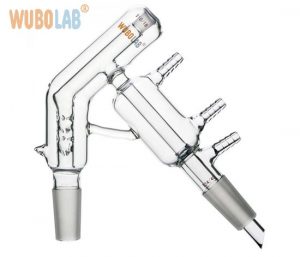
Vigreux vs packed columns. A Vigreux column uses glass indentations along the wall; those indentations create contact surfaces with relatively modest liquid hold-up. A packed column fills the bore with packing that provides more surface area and can therefore offer higher separation efficiency for a given length—but typically retains more liquid by wetting those surfaces. LibreTexts: fractionating columns
Why hold-up matters. Liquid retained on column surfaces never reaches the receiver as product. For small samples, high hold-up can waste a meaningful fraction of the charge or smear composition across cuts. Choose the column for the separation task and sample scale, not solely by height or appearance.
Illustrative intuition only (not a guarantee): teaching references sometimes describe short Vigreux-style columns as providing on the order of a few theoretical plates under favorable conditions, while longer or well-packed columns can approximate more stages—exact performance depends on packing, boil-up rate, insulation, and mixture properties. Treat such figures as order-of-magnitude teaching aids, never as a specification for a purchased column. LibreTexts: fractionating columns
Fractional distillation apparatus
Suggested alt text: Labeled laboratory fractional distillation apparatus showing boiling flask, fractionating column, distillation head with thermometer at the sidearm, water-jacketed condenser, and adapter leading to receivers (or a cow/fraction collector).
A typical bench train follows the path from a heated flask through the column and head to a condenser and receiver. The fractionating column is the defining addition to a simple-distillation arrangement. Use the laboratory’s approved setup to establish the exact geometry and connections. University of Colorado: fractional setup
| Component | Function | What to check |
|---|---|---|
| Boiling flask and controlled heater | Hold and heat the mixture | Flask, heating method and boiling control specified by the procedure |
| Fractionating column | Provide repeated liquid-vapor contact | Column type, dimensions and connections |
| Head and temperature sensor | Direct vapor onward and measure it | Sensor location in the vapor path |
| Condenser | Convert outgoing vapor into liquid | Cooling arrangement and outlet connection |
| Adapter and receivers | Transfer and collect fractions | A receiving arrangement that supports the planned fraction changes |
These functions follow the representative laboratory assembly described in Columbia’s distillation experiment. Related background on flask selection appears in WUBOLAB’s guides to laboratory flask types and distillation flasks.
Buyer / specification checklist
Before requesting a quotation, translate the method into interfaces and service conditions:
- Joint size — e.g. 24/40, 19/26, or other mating standards used throughout the train; adapters and joints are mating interfaces buyers must specify consistently.
- Column type — Vigreux (indentations, often lower hold-up) vs packed (more surface, potentially higher efficiency, more retained liquid); note preferred length/diameter if known.
- Approximate dimensions — flask volume, column length/bore, condenser jacket length.
- Condenser style — Liebig, Graham, Allihn, or other distillation condensers suited to the vapor load and cooling plan.
- Receiver plan — single receivers, sequential flasks, or a cow / fraction-collector style arrangement when multiple cuts without breaking vacuum or joints are required (receivers and short-path collection hardware—not a full fractionating-column kit page).
- Atmospheric vent vs vacuum path — preserve the method’s intentional vent, or design a continuous vacuum path with appropriate adapters.
- Vacuum service rating — when reduced pressure is planned, confirm glassware and assemblies approved for vacuum service; a material label alone does not establish the rating of an assembled train.
Supports complete the train. Clamps should hold the apparatus securely without stressing the glass or forcing misaligned joints. University of Vermont: glassware handling Practical handling tips for common organic-lab equipment are summarized in WUBOLAB’s equipment tips guide.
In a representative head, the thermometer bulb belongs near the sidearm so it measures vapor proceeding toward the condenser. Its precise position follows the head geometry and method; a misplaced bulb can give a misleading reading. University of Colorado: thermometer placement
For a conventional water-jacketed condenser, coolant travels through the jacket separately from the sample. Water enters at the lower connection and leaves at the upper connection to fill the jacket. Other condenser designs should follow their equipment instructions. LibreTexts: condenser connections The pressure arrangement must also preserve the method’s intentional atmospheric vent or designed vacuum path.
BOM → catalog role
| Bill of materials item | Typical catalog / sourcing role |
|---|---|
| Boiling / distillation flask | Standard flask categories; see flask types and distillation flasks |
| Fractionating column (Vigreux or packed) | Often inquiry / custom when no dedicated category is listed—specify type, dimensions, and joints |
| Distillation head + thermometer | Head geometry and thermometer adapter as mating parts; inquire if not listed as a kit |
| Condenser (Liebig, Graham, Allihn, etc.) | Condensers product category |
| Vacuum / distilling adapter (if needed) | Adapter matched to joints and vent or vacuum path; inquire for custom joints |
| Distillation receivers or cow receiver | Distillation receivers / collection (receivers, cow, short-path collection—not a full column kit) |
From setup to collected fractions
The following sequence explains the purpose of a run. The chemical-specific SOP and risk assessment supply its operating settings and controls.
- Prepare the apparatus: Confirm the method, inspect the glassware, assemble the supported train, and establish the required cooling and pressure arrangement. Connect condenser water lower-in, upper-out for a conventional jacketed condenser.
- Establish fractionation: Charge and heat according to the procedure, allowing liquid-vapor contact to develop and column surfaces to wet before demanding substantial collection. A slow, steady boil-up rate and time for equilibration support separation better than aggressive heating. Insulation is sometimes used in general lab practice to help maintain a temperature gradient along the column; follow the method’s instructions rather than treating insulation as a product claim.
- Collect separate cuts: Use the method’s controlled collection rate and clearly labeled receivers. Rapid collection can impair the equilibration needed for separation.
The key operating principle is to allow the column time to perform its separation function. LibreTexts: fractional-distillation procedure
- Record the run: Track head temperature (thermometer at the sidearm vapor path) alongside collected volume and fraction identity. These observations help identify changes in the distillate and show where one collection period differs from another.
- Assess the result: Keep uncertain cuts separate until their composition has been checked. A temperature trend helps organize collection, but a steady reading alone does not establish purity. George Mason University’s laboratory exercise explicitly checks the interpretation of distillation data by gas chromatography. GMU: interpreting distillation results
For suitable volatile organic samples, gas chromatography can help assess composition. Quantitative interpretation needs an appropriate method: standards and detector-response corrections may be necessary before peak areas represent component percentages. Decide what result will count as acceptable before combining fractions or claiming that purification succeeded. Columbia: analysis of fractional-distillation samples
- Finish under the approved procedure: Stop before distilling the flask dry, then follow the prescribed shutdown and cooling sequence. Do not treat the absence of further collected liquid as a reason to keep increasing heat. LibreTexts: stopping a distillation
Simple vs fractional distillation (and vacuum)
When to use fractional distillation
Consider fractional distillation when:
- The mixture contains two or more volatile liquids that need enrichment beyond a single vaporization–condensation step.
- Simple distillation has already proven inadequate for the required composition, or the method predicts insufficient enrichment.
- You need multiple cuts whose compositions change over the boiling range, and you will verify those cuts analytically.
- Relative volatility and required purity justify the added column hold-up, equilibration time, and apparatus complexity.
Simple distillation may still be the better choice when separating a volatile liquid from a clearly nonvolatile contaminant, or when the mixture separates readily enough for the intended purpose without repeated equilibration. University of Colorado: choosing a distillation approach
Simple vs fractional: separation arrangement
Fractional distillation adds repeated equilibration when the basic flask-to-condenser separation is inadequate. Start with the feed composition and the result you need. Relative volatility describes how differently the components favor the vapor phase, which helps explain why some mixtures separate more readily than others. A useful selection therefore considers both the mixture and the separation task—how much enrichment is needed—rather than whether a column appears more sophisticated. HKUST: relative volatility and separation tasks
Rule-of-thumb boiling-point gaps (use with caution). Textbooks and teaching resources disagree on a single ΔT cutoff. Some introductory sources treat roughly a 25 °C boiling-point difference as a rough boundary favoring simple vs fractional approaches; others note that mixtures with boiling points less than about 100 °C apart may still need a fractionating column for useful separation. Relative volatility and the required purity matter more than any single temperature-gap rule. Treat published cutoffs as orientation only, not as laboratory decision criteria for a specific feed. University of Colorado: choosing a distillation approach · LibreTexts: fractional-distillation overview
Vacuum fractional distillation
Vacuum distillation means operation below atmospheric pressure. Lowering pressure lowers boiling temperature, which can make reduced-pressure operation relevant when atmospheric boiling would require undesirable heating. University of Colorado: vacuum distillation
Fractionation and vacuum are independent choices. Reducing pressure does not replace the need for repeated vapor–liquid contact when components still co-distill too closely at the new boiling temperatures. Vacuum fractional distillation therefore still uses a column (or equivalent stages) under reduced pressure, with glassware and seals rated for vacuum service.
On the bench, contrast two common geometries:
- Classic column train — boiling flask, fractionating column, head, condenser, and receivers under a controlled vacuum path when heat-sensitive but still column-separable mixtures require fractionation at lower temperature.
- Short-path distillation — shorter vapor path and different geometric goals, often favored for heat-sensitive materials when minimizing residence time and surface exposure matters more than maximizing theoretical stages in a tall column.
Industrial vacuum fractionators illustrate the same principle—fractionation plus reduced pressure—but their process configuration is not a template for laboratory dimensions or settings. Penn State: atmospheric and vacuum fractionation
Two-dimension decision table
Read the comparison as two dimensions. Select a separation arrangement, then determine the pressure conditions appropriate to the method.
| Choice | Problem it addresses | What it changes | What still needs checking |
|---|---|---|---|
| Simple distillation | A separation achievable without a fractionating column | Uses the basic flask-to-condenser train | Whether the distillate meets the required composition |
| Fractional distillation | Inadequate enrichment from the basic separation | Adds repeated equilibration in a column | Mixture behavior, column performance and collected-fraction quality |
| Atmospheric operation | A method suitable at atmospheric pressure | Establishes the pressure regime | Heating conditions and the intended vent path |
| Reduced-pressure operation | A need to boil at lower temperature | Lowers operating pressure | Apparatus suitability and the resulting boiling conditions |
The first two rows concern separation; the last two concern pressure.
This leads to a practical decision sequence: define acceptable composition, assess whether a basic distillation can reach it, and add fractionation where the evidence warrants it. Reducing pressure alone is not evidence that a particular purity will be reached; the chosen method still needs to deliver the required separation.
If a mixture’s equilibrium behavior prevents the desired result at the proposed pressure, changing ordinary column operation is not a substitute for reconsidering the separation method. Azeotropes are a particularly important example of this limitation. RSC research on azeotropic restrictions
Laboratory and petroleum applications
Laboratory separation and purification
In laboratory teaching and purification, fractionation is useful for suitable mixtures of volatile liquids when repeated enrichment improves the separation. Collected portions can then be examined to see how the composition changes during the run. Columbia’s distillation experiment combines fraction collection with examination of the separated material, connecting the apparatus to a measurable outcome. Columbia: laboratory distillation
Calling a portion a fraction describes how it was collected, not a purity grade. A fraction may still be a mixture, even when its boiling range differs from those of neighboring fractions. For a purification or recovery task, define the required composition before deciding which portions are useful. UCLA: the meaning of a fraction
Refinery fractions are boiling-range mixtures
Petroleum refineries apply fractionation to a much broader mixture. Atmospheric distillation separates heated crude oil into fractions associated with different boiling ranges; lighter fractions occur higher in the tower and heavier fractions lower down. Further conversion, treatment and blending are part of producing finished petroleum products. A refinery fraction should therefore not be described as a pure chemical or automatically equated with a finished fuel. U.S. EIA: the refining process
Heavier material can undergo vacuum fractionation to separate it under reduced-pressure conditions. These refinery operations illustrate the same distinction between fractionation and pressure, but their process configuration is different from a bench glassware train. Use the industrial example to understand the principle, not to select laboratory dimensions or operating settings. Penn State: refinery distillation units
Separation limits, troubleshooting, and safety
Recognize equilibrium and operating limits
At an azeotropic composition, liquid and vapor co-distill without a composition change at the stated pressure. Ordinary fractional distillation at that pressure cannot keep enriching the mixture through that boundary. Feed composition also matters to what can be reached. When the desired purity conflicts with this behavior, the problem lies in the proposed separation, not simply in having too short a column. LibreTexts: azeotropes
Other disappointing results can come from operation. Surface wetting is expected in a column, but substantial liquid pooling or moving upward indicates flooding. Excessive collection can also reduce the contact needed for fractionation. Treat these observations as reasons to follow the procedure’s stop-and-check provisions, rather than compensating by increasing heat. LibreTexts: flooding and collection
An unexpected temperature reading also deserves a sensor check once the apparatus is safely stopped and cooled. A probe outside the intended vapor path may report a misleading value, so verify its position against the setup instructions before interpreting the reading as a change in composition. Thermometer placement guidance
Control heating and reduced-pressure hazards
Use the lab’s validated procedure, chemical hazard assessment and required protective controls. Inspect glassware before use, support it without forcing joints into alignment, and avoid overtightened clamps. Consider the chemical exposure and temperature changes the assembly will experience, including during startup and cooling. University of Vermont: safe glassware handling
Bumping can throw liquid suddenly through the apparatus. Use the prescribed boiling control, and never add boiling stones to liquid that is near boiling. Peroxide-forming chemicals require particular attention because distillation can concentrate hazardous residues. These are chemical-specific hazards to settle before heating begins. Cornell: distillation safety
An atmospheric setup needs its intended vent path, and distillation should stop before the flask runs dry. Keep these requirements in the setup and shutdown procedure. LibreTexts: apparatus and shutdown precautions
For reduced-pressure work, use inspected glassware approved for vacuum service, appropriate protection and suitable pump exhaust handling. A material label alone cannot establish the service rating of an assembled train. Cornell: glass under vacuum
Evacuate the apparatus gradually under the approved procedure to reduce bumping. Cornell: reduced-pressure distillation
Specifying laboratory glassware
Translate the method into a component specification before requesting a quotation. Confirm chemical compatibility and the manufacturer’s limits for the intended service, rather than assuming that visually matching parts have the same capability. University of Vermont: selecting appropriate glassware
A useful inquiry should include:
- Mixture: Chemical identities and the expected composition range.
- Separation goal: Batch scale, required fraction quality and the planned analytical check.
- Operating conditions: Proposed pressure and temperature conditions from the validated method.
- Column and interfaces: Column design (Vigreux or packed), dimensions, joint types and mating components.
- Collection arrangement: Condenser requirements (Liebig / Graham / Allihn or other), adapter geometry and receiver changes (including cow / fraction collector if relevant).
- Documentation: The drawings, compatibility information and service limits needed to assess the proposed assembly.
Use the list as a request for confirmation; it is not a specification of any particular product.
How to inquire: Contact WUBOLAB with joint types (e.g. 24/40), approximate dimensions, pressure service (atmospheric or vacuum-rated), and column preference (Vigreux vs packed). Start from the listed laboratory condensers and distillation receivers pages; fractionating columns and custom joints are typically handled by inquiry when they are not listed as a dedicated category. Include mating dimensions and intended operating conditions so the discussion can focus on component options and the documentation needed to assess fit.
Fractional distillation FAQ
Does fractional distillation always produce pure liquids?
No. Fractional distillation enriches components only as the mixture’s equilibrium behavior allows; an azeotrope can limit ordinary separation at a fixed pressure. Assess a collected fraction with an appropriate analytical method when composition matters. LibreTexts: azeotropes and fraction assessment.
Is reflux the same as collected distillate?
No. Reflux is liquid returning through the column to participate in liquid-vapor contact. Distillate is the portion condensed and collected outside that internal separation path. The distinction explains why collecting faster is not necessarily the same as separating better. Fractionating-column theory
Can fractional distillation run under vacuum?
Yes. Fractionation describes repeated separation stages, while vacuum describes reduced operating pressure. They can be combined when the mixture and apparatus suit the method, with glassware approved for the reduced-pressure service. Vacuum fractionation and vacuum glassware requirements.
What apparatus do I need for fractional distillation?
A typical bench train needs a boiling flask, fractionating column (Vigreux or packed), distillation head with thermometer at the vapor sidearm, condenser, and receivers or a cow/fraction collector—plus the atmospheric vent or vacuum path the method requires. Specify joint sizes and vacuum rating when relevant; see the condensers and distillation receivers categories, and inquire for columns when not listed. University of Colorado: fractional setup
Vigreux vs packed fractionating column — which to choose?
Choose by separation task and sample scale. Vigreux columns (glass indentations) often retain less liquid; packed columns provide more surface area and can offer higher efficiency but usually higher hold-up—which matters for small samples. Height alone is not a sufficient selection rule. LibreTexts: fractionating columns
What is a cow distillation receiver for?
A cow (multi-arm) receiver lets you divert distillate into different flasks without fully dismantling the train—useful when collecting sequential fractions, including under reduced pressure when breaking joints would lose vacuum. It is a collection accessory, not a substitute for the fractionating column. See distillation receivers / collection hardware.
Define the separation and pressure needs first, decide how the collected fractions will be checked, then request glassware against the resulting component and interface requirements.